
PASSIVE COOLING BUILDING ENVELOPE



RF-Transparent Low-e Window Films
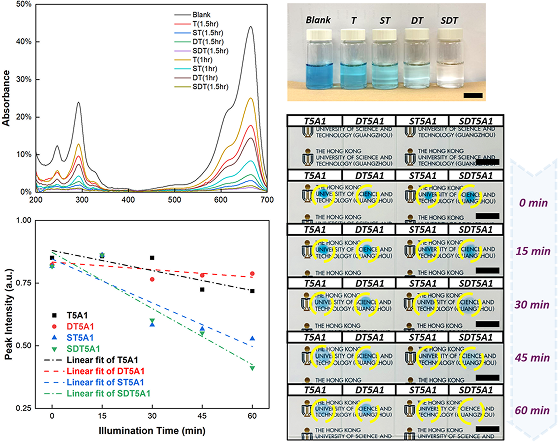
This is an energy-saving window film that does not block mobile phone signals. Conventional low-emissivity films rely on a metal layer to reflect infrared heat, but that same layer acts as a shield against radio-frequency signals. We adopted a laser-patterning-based fabrication strategy to introduce subwavelength periodic structures into metal-based low-e films on flexible substrates. These structures create a frequency-selective surface effect: radio-frequency signals can pass through, while the film continues to reflect thermal infrared radiation. The process has been demonstrated on a roll-to-roll compatible platform, confirming its suitability for large-area, continuous manufacturing. Prototype films maintain high visible transparency and effective thermal blocking, offering a practical way to combine energy efficiency with uncompromised indoor wireless communication.
Thermochromic Ionogel Smart Windows
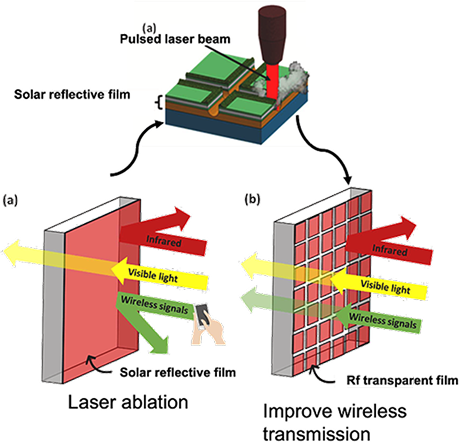
This is a window film that automatically turns darker when it gets hot, without any external power. The active layer is an ionogel—a composite of a polymer network and an ionic liquid. At room temperature the film is clear and lets in daylight; as the temperature rises, the hydrogen bonds between the polymer and the ionic liquid break, causing a phase separation that makes the film opaque and blocks a large fraction of the solar heat. Two key parameters can be tuned independently: the transition temperature is controlled by the choice and mixture of ionic liquids, while the magnitude of the optical modulation is controlled by the film thickness, following the Beer–Lambert law. This means the smart window can be tailored for different climates and building orientations, providing adaptive solar regulation that helps reduce air-conditioning loads.
Temperature-Adaptive Modules (TAM)
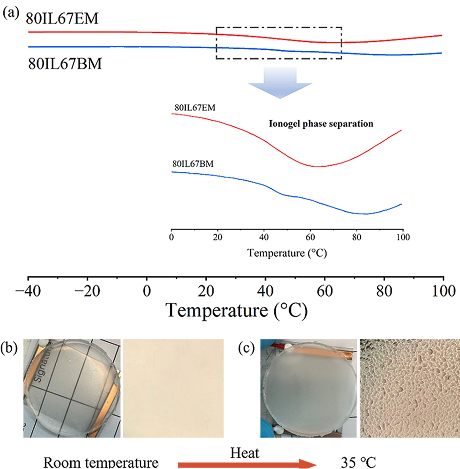
This is a building-skin module that moves by itself in response to temperature, needing no electricity, sensors, or motors. The design is inspired by the seismonastic leaf-folding of Mimosa pudica. The module has a Janus bilayer structure: one layer of hydrophilic cellulose nanofibers (CNF) that shrinks when it loses moisture at high temperature (negative thermal expansion), and one layer of hydrophobic ethyl cellulose (EC) that expands with heat (positive thermal expansion). This mismatch forces the module to curl upward when it is hot, exposing an underlying radiative cooling surface, and to flatten back down when it is cool, covering the cooler and acting as an insulation layer. TAMs have been produced in four colours and show tensile strength comparable to high-density polyethylene. In field tests in subtropical Hong Kong, they achieved peak daytime cooling of 8.8°C, while automatically returning to insulation mode at night, effectively suppressing the overcooling that plagues static radiative coolers.
Thermochromic Building Skin with Integrated Energy Harvesting
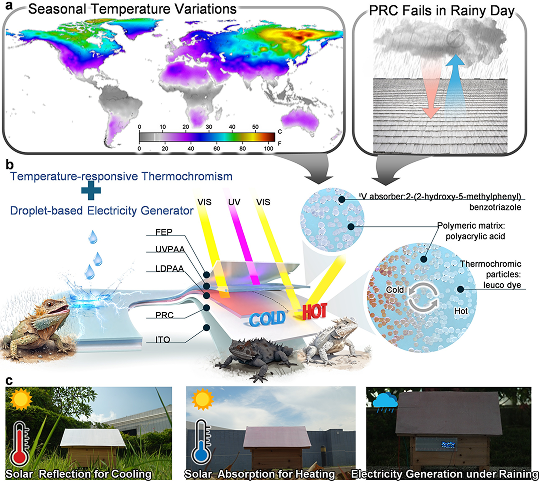
This is a multi-functional façade film that switches colour with temperature and generates electricity from raindrops. Inspired by the horned lizard, the metafilm contains a leuco-dye-doped thermochromic layer: in hot weather it turns white to reflect sunlight and enhance cooling; in cool weather it turns dark to absorb solar heat and keep the building warm, thereby avoiding the overcooling problem of conventional radiative cooling. The top layer is a hydrophobic fluorinated ethylene propylene film, and when raindrops strike it, instantaneous voltages up to 200 V are generated, harvesting the kinetic energy of rain. The transition temperature can be precisely tuned from 3.4°C to 30.1°C. Accelerated weathering tests confirm long-term durability, and cross-seasonal outdoor tests in Hong Kong showed sub-ambient cooling in summer and clear heating benefits in winter, making it a more resilient and versatile building envelope for real weather.
Adaptive Cooling Paints with Phase Change Materials
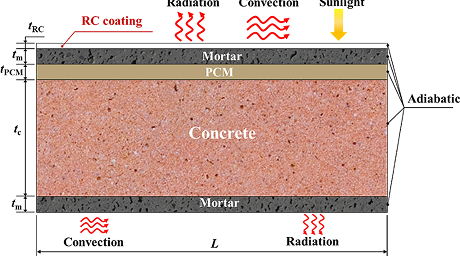
This is a roof system that combines radiative cooling with thermal storage to solve the winter overcooling problem. Ordinary radiative cooling roofs keep emitting heat even on cold days, raising the heating demand. Here, a layer of phase change material (e.g. paraffin) is integrated beneath the cooling surface: it melts and stores heat when the roof gets hot, and solidifies and releases heat when the temperature drops, smoothing out temperature swings. An optimization framework coupling building energy simulation with deep reinforcement learning was used to determine the best PCM melting point, thickness, and layout. The optimized system lifts the maximum annual electricity saving rate from 35.1% (standard reflective roof) to 45.7%, and the carbon reduction potential reaches about 3,162 g CO₂ per square metre per year. It also extends the viable climate range, enabling effective energy savings even in regions where conventional reflective roofs would fail because of winter heat loss.
Novel RC-PCM Roof
Inorganic-Shell PCM Microcapsule Insulation Panels
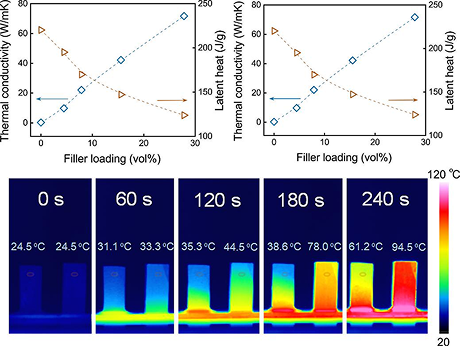
These are wall and roof panels that work like a thermal battery. Inside a cement-based board, millions of microcapsules each contain a phase change material (PCM) sealed within a hard inorganic shell. When the indoor temperature rises, the PCM core melts and absorbs heat; when it cools down, the core solidifies and releases the stored heat. The inorganic shell solves two critical problems of conventional organic-shell microcapsules: low thermal conductivity and leakage. Systematic optimisation of the synthesis parameters has produced microcapsules with high latent heat, good dispersibility, and enhanced thermal conductivity. The resulting composite panels are designed to maintain indoor temperature at a comfortable level, and it is estimated that at least 15% of cooling energy costs can be saved after launching this integrated strategy.
Multi-Functional Self-Cleaning Nanocoating
This is an ultra-durable coating applied to the outside of building walls and roofs. Its self-cleaning function works through photocatalysis: under sunlight, the coating breaks down organic pollutants that stick to the surface into harmless small molecules, which are then washed away by rain. The coating has been engineered for extraordinary durability, meaning it withstands years of UV exposure, thermal cycling, and abrasion without losing its effectiveness. By keeping building surfaces clean with no manual intervention, it directly reduces the life-cycle maintenance costs of green buildings.